
UCCLAN at IPBES

UCCLAN joined the Intergovernmental Science-Policy Platform on Biodiversity and Ecosystem Services (IPBES) as an observer organization in 2021 and has attended IPBES plenary negotiations every year -- sending both virtual and in person delegations -- since IPBES-8 in June 2021.
IPBES is the global science-policy interface on biodiversity and ecosystem services: experts review worldwide evidence to produce thematic assessments on the state of biodiversity, as well as solutions to address the biodiversity crisis, that will guide policymakers. At annual IPBES plenaries, over 150 member state governments** negotiate, line-by-line, a Summary for Policymakers (SPM) for each assessment. IPBES members also negotiate on topics such as building capacity and supporting policy. The outcomes inform policy at all levels, from national and regional governance to Multilateral Environmental Agreements (MEAs), including the UN Convention on Biological Diversity and its Kunming-Montreal Global Biodiversity Framework (KM-GBF).
As volunteer delegates, UCCLAN members have contributed their diverse biodiversity conservation and policy expertise to IPBES processes -- including through dialogues, draft text reviews, discussions of scope, and SPM negotiations -- on several critical assessments, such as the:
- Thematic Assessment Report on the Underlying Causes of Biodiversity Loss and the Determinants of Transformative Change and Options for Achieving the 2050 Vision for Biodiversity (aka the Transformative Change Assessment)
- Thematic Assessment Report on the Interlinkages among Biodiversity, Water, Food and Health (and Climate) (aka the Nexus Assessment)
- Methodological assessment of the impact and dependency of business on biodiversity and nature’s contributions to people (aka the Business and Biodiversity Assessment)
- Methodological assessment on monitoring biodiversity and nature’s contributions to people (aka the Monitoring Assessment)
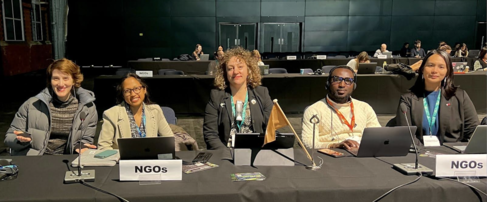
At IPBES-12 in 2026, 12 UCCLAN delegates from 10 countries -- ranging from Ghana and the Philippines to Croatia and the United Kingdom -- participated in preparations. Nine of these delegates attended IPBES in person, and the others supported remotely. Several UCCLAN members attending IPBES with other delegations and current Conservation Leadership MPhil students also joined UCCLAN meetings and dialogues. Read UCCLAN IPBES-12 report.
UCCLAN’s goals for IPBES participation include:
1.Learn through participation.
At IPBES-12, UCCLAN delegates engaged with national delegations, IPBES experts and other stakeholders, observing formal sessions and informal consultations that shaped the final wording of the Business and Biodiversity Assessment Summary for Policymakers (SPM). Delegates described the experience as learning how evidence becomes policy-relevant language, something difficult to understand without being present in the room. The process combined technical understanding, diplomacy and communication skills, demonstrating that engagement in science-policy processes can itself be a form of capacity building. UCCLAN delegates also followed discussions on institutional effectiveness and the future work programme of the IPBES platform. Delegates undertook informal outreach among assessment authors to encourage exchange of emerging findings across processes.
2.Contribute technical expertise to IPBES processes and negotiations.
At IPBES-12, both through prior review and engagement with national delegations, UCCLAN delegates contributed to several textual developments in the final Business and Biodiversity Assessment SPM, including increasing specific language around gender equality through inclusion of “women and girls” when describing exposure of smallholders to biodiversity-related risks in value chains; recognition of alternative economic models such as the bioeconomy, circular economy and degrowth; recognition of academia within the category of “other actors”; and removal of references to artificial intelligence from a key message and accompanying table, where the potential adverse biodiversity impacts were not adequately contextualised. These changes illustrate how observer engagement and dialogue with Member States can shape policy-relevant wording.
3.Engage collaboratively with the IPBES community of stakeholders.
UCCLAN works collaboratively with other IPBES stakeholders. For IPBES-12, UCCLAN actively contributed to the Open-ended Network (ONet) stakeholder community in preparing for Stakeholder Day ahead of the Plenary and throughout the plenary. ONet engagement took place over several months of advance preparatory meetings. UCCLAN delegates participated in the ONet-led IPBES-12 Stakeholder Day, which was held the day before negotiations began, and in ONet’s daily meetings. ONet’s closing IPBES-12 stakeholder statement, delivered in Plenary, included language proposed by the UCCLAN delegation highlighting the importance of leadership for transformative change. UCCLAN engaged with other stakeholder groups at IPBES-12, as well, including the International Indigenous Forum on Biodiversity and Ecosystem Services (IIFBES).
4.Grow leadership skills and capacity.
UCCLAN’s IPBES participation provides first-hand exposure to environmental leadership challenges, such as how science can be politicised and how compromise can be reached while maintaining scientific integrity. For newer participants, the Plenary serves as an intensive capacity-building experience; for experienced members, it deepens understanding of negotiation dynamics and is an opportunity to strengthen relationships with national delegates, focal points, the IPBES Secretariat, and other stakeholders. The IPBES-12 UCCLAN delegation operated through shared team leadership. The delegation co-leads coordinated the process while encouraging members to take ownership of tasks, from reviewing text to team leadership to engaging with National Focal Points during negotiations. This was partly a response to the voluntary nature of participation, but also a deliberate learning approach. Participants practised leadership roles in a live negotiation environment while supporting each other’s development.
What does participation look like for UCCLAN delegates?
Preparing for IPBES-12 participation required learning both the institutional procedures and the technical content of the assessment under negotiation, the Business and Biodiversity Assessment, as well as other key items under negotiation, such as capacity building measures.
The UCCLAN IPBES-12 working group was created in August 2025, six months before the Plenary, through an open call to alumni. Meetings were then held roughly every two weeks and focused on building shared understanding of IPBES as a platform, negotiation dynamics and assessment content.
More specific preparations included:
- Introduction to IPBES review and approval procedures.
- Collective review of the assessment text.
- Discussion of the platform’s mid-term review.
- Negotiation training.
- Identification of and agreement on priority themes for the delegation.
- Structured tools for communicating proposed text changes.
- Development of shared one-pagers, tracking documents and tables linking SPM key messages to suggested additions and rationale.
- Agreement on terms of reference and roles for the delegates, a schedule of participation and approaches to shared leadership.
Delegates also participate in follow up discussions to debrief and report on their experience, and to consider UCCLAN’s contributions to ongoing discussions on distribution and uptake of the assessments, as well as cross-coordination with UCCLAN members engaging as delegates to other MEA’s, especially the CBD.
How do UCCLAN members engage in future IPBES plenaries?
IPBES participation is open to all UCCLAN members who are willing and have the time to commit to advance preparations and roles on the delegation (either virtual or in person). IPBES plenaries are usually held annually and an advance call for UCCLAN members who are interested in participating is circulated by the alumni office in collaboration with the volunteer Co-chairs of the delegation (Co-chairs are determined based on who is available to make the time and energy commitment and these positions are not fixed -- it is helpful to have some prior IPBES experience).
While delegates are self-funded, the co-chairs work with the UCCLAN alumni office to identify possible sources of delegate funding to help cover partial or complete costs.
If you are interested in joining the next IPBES delegation, please contact the Conservation Leadership Networks Manager to be placed in touch with the current co-chairs.
** Although IPBES is not a UN entity, the Secretariat is managed by the UN Environment Programme.