

MPhil in Conservation Leadership student Phoebe Ndiema shares insights at the 24th Session of the UN Permanent Forum on Indigenous Issues
Phoebe Ndiema, an MPhil in Conservation Leadership student at the University of Cambridge, recently participated in the 24th Session of the UN Permanent Forum on Indigenous Issues (UNPFII) in New York.
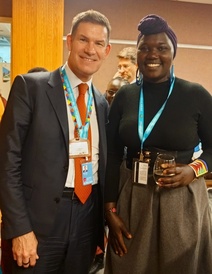
Phoebe Ndiema with Dr. Robin Mearns, Global Director for Social Development
at the World Bank, during the 24th Session of the UN Permanent Forum on Indigenous Issues.
As a recipient of support from the UN Voluntary Fund, Phoebe brought valuable insights from her community in Mt. Elgon, Kenya, to this global platform focused on implementing the United Nations Declaration on the Rights of Indigenous Peoples (UNDRIP).
Intergenerational Dialogue on the World Stage
A highlight of Phoebe's participation was her contribution to a high-level panel on intergenerational dialogue, moderated by the President of the United Nations Economic and Social Council (ECOSOC), Hon. Bob Rae. Sharing the stage with distinguished participants including Aluki Kotierk, Chair of the UNPFII, and Dr. Albert Barume, UN Special Rapporteur on the Rights of Indigenous Peoples, Phoebe emphasized the critical role of Indigenous youth in conservation leadership.
"I was able to share experiences from my community in Mt. Elgon, where young people are leading community-based biodiversity monitoring efforts that integrate traditional knowledge with scientific approaches," Phoebe explained. "These initiatives are not only enhancing local stewardship but also creating pathways to decolonize conservation practices."
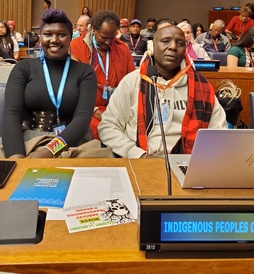
Martin Simotwo, Ogiek Elder and Board Member of CIPDP
Phoebe's work highlights the importance of integrating Indigenous knowledge with scientific approaches in conservation. During the forum, she connected with various professionals including Dr. Robin Mearns, Global Director for Social Development at the World Bank and a University of Cambridge alumnus, building networks between academic research and policy implementation.
Reflecting on her experience, Phoebe noted that while much of the forum centered on addressing violations and injustices, there is also a need to amplify success stories of UNDRIP implementation and community-led solutions.
"There is much to critique in the global governance of Indigenous rights, but there is also much to celebrate," she observed. "The future of conservation, of climate justice, and of Indigenous empowerment lies in meaningful collaboration, intergenerational leadership, and the centering of knowledge systems that have sustained lands and cultures for millennia."
The Masters values Phoebe's contributions to this important global dialogue and looks forward to supporting her continued work at the intersection of Indigenous rights and environmental conservation.